










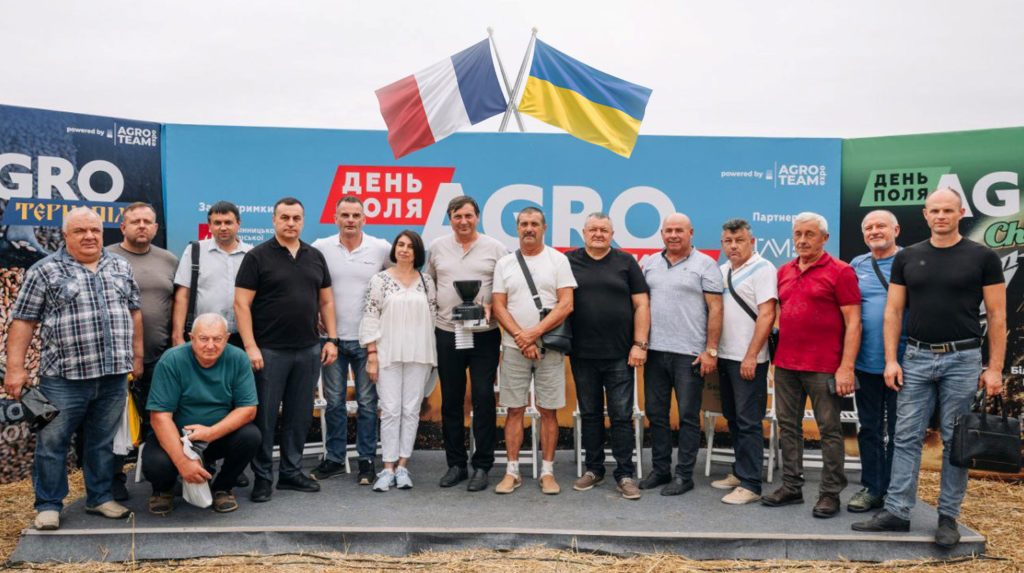
A strategic programme supported by the French government
The objective of this programme was to demonstrate the relevance of the bio-solutions developed by Elicit Plant in addressing the impacts of climate change on Ukrainian agriculture and food sovereignty, and to show how French innovation contributes to the ecological transition and sustainable development by strengthening crop resilience to climate change.
This funding enabled the implementation of a large-scale demonstrator designed to prove that solutions stemming from French research can provide concrete answers to global agricultural challenges. The programme aimed to assess the effectiveness of our phytosterol-based biosolutions in limiting the impact of water stress on yields of maize, soybean, and sunflower crops.
A total of 20,000 litres of solutions were made available to participating farms, half of which was financed by the French government under the FASEP programme, with the remaining half provided by Elicit Plant.
Independent and impartial evaluation
To ensure the reliability of the results, trial monitoring and the analysis of agronomic and yield data were carried out by two independent Ukrainian partners: Frendt, a company specialising in digital technologies applied to agriculture, and the Dnipro State Agrarian and Economic University (DSAEU).
Frendt was responsible for conducting field visits during the vegetative phase to record visual effects related to the use of our products, as well as for analysing yields using precision agriculture technologies (mapping, weather stations, water balance monitoring, etc.).
The University (DSAEU) ensured follow-up with farmers to remind them of the objectives of the study and to collect as many results as possible using a conventional yield measurement methodology based on harvested weights over defined areas.
This approach guarantees the impartial nature of the programme, which is essential for a demonstrator financed with public funds.
Strong agronomic and economic results
The programme was implemented in southern Ukraine:
- 123 farms participated,
- More than 70 trials were exploitable despite field constraints related to war and drought,
- Covering a total area of nearly 15,000 hectares.
Analyses show improved resilience to water stress despite a challenging context, with yield gains observed in more than 80% of the maize and sunflower trials, reaching up to +12% on average.
Overall, the programme generated more than €1.3 million in additional gross margin for farmers, despite extreme climatic conditions. Within the context of this FASEP demonstrator, and taking into account the specific conditions of 2024 and the product mix defined to address maize, sunflower, and soybean crops, this resulted in €4 generated for every €1 invested — a fourfold return compared to the initial investment by the French government.
These figures are not merely data points: they represent secured income, farms kept afloat, and a direct contribution to Ukraine’s food sovereignty.
The programme enabled Ukrainian farmers to secure part of their production while also reinforcing the recognition of French innovation, demonstrating that solutions derived from research can find their place in agricultural regions facing climate-related challenges.